

Curators: Alina Hagen, Vianney Parrinello
Exhibition Team: Emily Turbeville, Gabrielle Streeto, and Alexandra Dardet
- Exhibition Link
- Exhibition Proposal: Alina Hagen and Vianney Parrinello
- Vision Statement: Alina Hagen and Vianney Parrinello
- Task Breakdown: Alina Hagen and Vianney Parrinello
- Budget Proposal: Gabrielle Streeto
- Exhibition Plan and Design: Emily Turbeville
- Curatorial Statement: Alina Hagen and Vianney Parrinello
- Interpretive Labels: Alina Hagen and Vianney Parrinello
- Elevator Pitch: Alina Hagen and Vianney Parrinello
- Marketing Plan: Gabrielle Streeto
- Advertisement Graphics: Gabrielle Streeto
- Fundraising Plan: Alexandra Dardet
- Copyright permissions
- Works Cited
Exhibition Link
This exhibition was produced fully online due to lingering Covid-19 restrictions still in place at the time of its conception. The exhibition was posted on an 3d rendering platform called Art Steps. The exhibition can still be viewed in full at the following link address.
Exhibition Proposal: Alina Hagen and Vianney Parrinello
Vision Statement: Alina Hagen and Vianney Parrinello
This exhibition seeks to inspire young adults to utilize dreams in new ways to interpret
and contemplate the unconscious through art. Throughout history, dreams were thought to be
visions of the future or divine revelations from the gods; however, in recent history, many scientists have concluded that they are simply the brain making sense of active neurons during the night. However, the connection that dreams have to our subconscious desires and memories cannot be ignored, as many psychologists counter the neuroscientific community, claiming that dreams can help people process recent events they have been through and provide a deeper look into the mental state of the individual. Despite humans experiencing dreams almost every night, science still needs to develop the technology to allow onlookers to see into the dreams of others. This oversight on science’s part can be overcome through art, a medium that enables artists to capture the link between waking and dreaming and visualize the visions of the night that science cannot. This exhibition seeks to connect the audience to their unconscious by creating an immersive experience where they are guided through five different types of dreams that can occur throughout their life. We hope that the audience will recognize themselves and their own subconscious in the art of this exhibition and encourage them to dig deeper into their dreams
each night, inspiring them to live life more creatively and freely.
Task Breakdown: Alina Hagen and Vianney Parrinello

Regarding task breakdowns, the exhibition team leads, Alina Hagen and Vianney Parrinello, broke down our team responsibilities into nine different sections according to our deliverables. Deliverables consisted of one to two significant tasks with several subtasks attached for each team member to complete in a timely duration according to the planned opening of the exhibition. Both co-curators, Alina Hagen and Vianney Parrinello completed the first main deliverable. It consisted of drafting an exhibition proposal and deciding on an umbrella theme that happened to come down to time and memory. Subtasks included creating a more focused concept for the show on which we would base our ideas and pick out necessary objects. Quickly following this deliverable was the vision statement also created by the curators. Subtasks were based on the exhibition’s primary goal, the generation of critical concepts, and the outcome of the exhibition as a whole.
Once the Co-Curators put together a general concept and object list, image permissions had to be gathered before any design plans could occur. As a team, we contacted both collection holders of the UT and USF collections to gather copyright agreements from each holder of the works we planned to use. Within two weeks, copyright access was permitted for all works from UT and USF, except for two works created by Douglas Brown. The exhibition team did its best to contact the copyright holder before the exhibition team leads decided to use the images in terms of fair use for education reasons, with the understanding that if the copyright holders for Douglas Brown’s work came forward, it would be removed from the exhibition at their request.
After all permissions were granted that were possible; the curators began working with the design team to correlate ideas for the setup of the show. Subtasks included sketching up ideas and design choices and placements for objects within the virtual space of artsteps, an online exhibition building site. While this occurred, the co-curators generated a curatorial statement to aid in the design of the exhibition and hone in on a narrative walkthrough and significance factor of the show to make better decisions for the design.
With a possible draft correlated with the show’s design, curators and design team members worked together to implement object records into CMS. With all information on the objects in one place, the exhibition team could easily design graphics, labels, and text panels based on the information gathered for the records. Design members focused on graphics and tombstone labels for the exhibition. At the same time, curators took on interpretive labels and info panels that needed further research.
While creating labels and working on designs, all team members worked together to define a budget, marketing plan, and fundraising plan. The exhibition team leads assigned these tasks at the beginning of the creation of the design plan and worked on them throughout the exhibition design to adapt and work as closely together in case any changes needed to be made. Each section was broken up and tasked to one team member, who would report to exhibition team leads for editing and revising.
The final deliverables included creating a virtual exhibition mockup that would follow in a presentation. The final mockup allowed all the different sections worked on through the creation of the exhibition to come together as one concise project. As a team, all work previously completed was edited, revised, and double-checked before the date of the presentation.
Budget Proposal: Gabrielle Streeto
Due to the nature of this exhibition, the budget looked very different than what it might have looked like if the exhibition had been in person. When the budget was initially drafted, it was divided into two main parts, the first dealing with image permissions and the other being compensation for the workers. Image permission can sometimes be paired with a small fee that consists of the borrower (us) paying the fee to borrow the image of that artwork. There were no image costs posted anywhere, but due to the nature of the exhibition, it was presumed that there could be a small fee, which was estimated to be roughly $50 per image. The exhibition requested 36 images between two institutions, meaning $1800 of the budget was allocated for possible image permission. The other portion of the budget consisted of having the funds to compensate the workers for their contribution to the project. Each worker agreed with a base pay of $20.00 an hour with a maximum of 6 hours of work completed each week. This allowed the budget to presume a total of $5,400 to accommodate for workers’ compensation. This gave the budget a grand total of $7,200.
While still developing, the final total for the budget ended be lower than the estimated total number. This is mainly because both institutions allowed our exhibition team to use images from their collections without any required fees. This allows all $1800 that was accounted for in the original budget to be removed, leaving the only portion of the budget dealing with the workers’ compensation. While this number is still developing, due to the project continuing to be developed, the workers are very competent, and it has led to tasks being completed faster than expected, leading to fewer hours put into work. As a result, many workers are coming under the maximum number of hours, leading to the estimated $5,400 needed to compensate the workers being ultimately lower. At the project’s completion date the total number of hours spent on the project between the five workers was 189 hours. This is much lower than what was expected and as a result the amount of money required to appropriately compensate the workers is totaled at $3,780. Due to the images having no image permission fee the budget ends with a total of only $3,780. This ends with the estimated budget being significantly lower than initially estimated and is credited to the nature of the exhibition. Its nature of being a student-led virtual exhibition with no public advertisements led to many elements typically associated with an exhibition and, ultimately, a cost, to be eliminated from the final budget.
| Week of: | Alina | Vianney | Emily | Alexandra | Gabby |
| 10/9/22 | 4 | 4 | 2 | 2 | 2 |
| 10/16/22 | 3 | 3 | 2 | 2 | 2 |
| 10/23/22 | 2 | 3 | 2 | 3 | 3 |
| 10/30/22 | 3 | 4 | 4 | 4 | 1 |
| 11/6/22 | 4 | 4 | 4 | 2 | 4 |
| 11/13/22 | 3 | 3 | 3 | 2 | 3 |
| 11/20/22 | 3 | 6 | 2 | 4 | 2 |
| 11/27/22 | 15 | 9 | 3 | 3 | 3 |
| 12/4/22 | 8 | 9 | 5 | 2 | 3 |
| 12/11/22 | 5 | 5 | 5 | 5 | 5 |
| Total Hours | 50 | 50 | 32 | 29 | 28 |
Exhibition Plan and Design: Emily Turbeville
Our plan for the outlined design is attached below, displaying an introduction section giving a brief history of dreams followed by six exploratory sections in the order of, Typical Dreams, Daydreams, Lucid Dreams, False awakening Dreams, Nightmares, and ending in a section on the known Science and Theories of dreams in terms of psychoanalysis and neuroscience. Each section is defined by an informative text panel about the type of dream section, displaying several objects that enhance and relate to the theme. The flow of each section creates a clockwise rotation starting at the entrance of the virtual museum.
Furthermore, the main choices considered when designing the exhibition were wall color, object order, and wall placement. The exhibition design team and the curators decided to keep the walls plain to highlight the pieces themselves and not take away from the vibrancy of specific pieces. The exhibition design team considered the objects’ locations in the gallery for positioning on a case-by-case basis, based on color, subject, and size. Much of the design process was trial-and-error regarding the whole gallery layout. The “movable” walls used were placed to keep the next section the visitor would traverse through a mystery and maintain the level of interest and anticipation high.
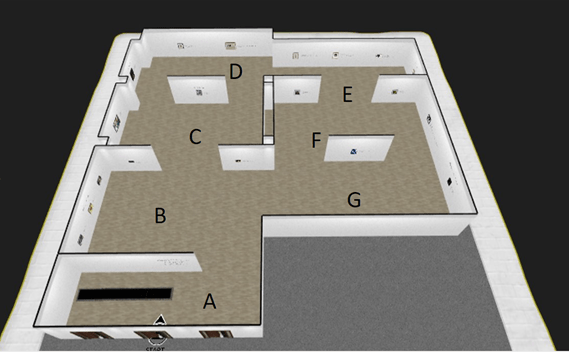
A: The History of Dreaming
- The Muse Appears
B: Typical Dreams
- TV Blends Series
- Dynamism Series
- Untitled #30, #16, #21
C: Daydreams
- History
- The Blue
- On Ramp
- Bull Creek Autumn II
- Bassin d’Argenteuil
D: Lucid Dreams
- Creating Order Out of Chaos (2)
- Nature of Time
- Traveler with Luggage
- Self Portrait Contemplating the Red Dog #30
E: Nightmares
- The Memory Tower
- Twainhouse Stackhouse
- Transplace
- Death Awaiting Within and Without the Door 1
- Death Shall Comfort Thee
- Deconstruction Guts 1
F: False Awakenings
- Library (2004) (USF)
- Study For Encounterings
- Mist of Spider City
- South Beach
- South Beach 2
G: The Science and Theory of Dreaming
- Untitled (Janet Jackson)
- Visitation 1,2,3
- Andante Spianato
Curatorial Statement: Alina Hagen and Vianney Parrinello
Subconscious Visions: Dreams of the UT and USF CAM Collections is a contemporary exhibition showcasing over 30 unique interpretations of the unconscious mind through art. This exhibition is designed to connect the audience with five of the known types of dreams that can occur throughout their life and explore the many different ways the subconscious presents itself during the night. Throughout history, dreams were thought to be visions of the future or divine revelations from the gods (Packer, 2002); however, in recent history, many scientists have concluded that they are simply the brain making sense of active neurons during the night (Cherry, 2020). Many psychologists, however, counter the neuroscientific community, claiming that dreams can help people process recent events and provide a deeper look into the mental state of the individual. Despite humans experiencing dreams almost every night, science has yet to develop the technology needed to allow onlookers to see into the dreams of others. This oversight on science’s part can be reduced through art, a medium that enables artists to capture the link between waking and dreaming.
Subconscious Visions is an exhibition in seven parts, one focusing on the historical understanding of dreams and how ancient understandings of dreams have impacted modern philosophical knowledge. Five focus on five different unique forms that dreams can take. Finally, the last focused on the contemporary scientific understanding of dreams and the unconscious.
The first section of this exhibition explores dreams’ historical relevance. The function of dreams has been the topic of numerous scientific, philosophical, and religious debates for millennia; beginning with Oneirology, the study of dreams, originating from the Babylonians, Ancient Egyptians, and Sumerians. Historically, dreams were thought to have been sent from a higher power, the Babylonians believing that good dreams were rewards sent by the gods and nightmares punishments sent by demons (Packer, 2002). This section features one work that aims to emulate this ancient understanding. The Muse Appears by Audrey Flack features a pop art rendition of a woman holding a pair of paint brushes, which symbolizes how dreams can appear to artists and inspire them to create their works. The Muse Appears also functions as a visitation from the exhibition to the audience, welcoming them into the exhibition space.
After the historical introduction, the exhibition moves into the main body of its subject: five of the different dreams that can occur during the night (van Eeden, 1913). The first section of this main body covers typical dreams or the dreams that occur most frequently during the night. On a typical night, humans can have between 3 to 6 different dreams a night; however, 95% of these visions are forgotten come morning. According to Sigmund Freud, an Austrian psychologist famous for his theories on the subconscious, typical dreams are composed of flashes and stills from memories and recent events and are often nonsensical to the waking mind (Freud, 1953). This section embodies this theory through collage photographic works and blurred out-of-focus works that combine several different photographs and stills. These works symbolize how most dreams are thought to be the brain’s way of processing events and cementing long-term memories.
The third section of Subconscious Visions explores the concept of daydreaming and how daydreams function as a waking stream of the subconscious. According to current scientific studies, the average person spends approximately 47% of their waking time fantasizing and daydreaming. Daydreaming, while not usually occurring during the night, is a stream of consciousness that acts as a detachment from current, external conscious settings into idealized versions of it similar to dreams (Gilbert, 2010). This section aims to capture this mild detachment and fantasization of reality through idyllically represented images created in expressionist styles. In contrast to nighttime dreams, Freud pointed out that there seems to be a “secondary revision” process in fantasies that makes them more lucid (Freud, 1953). Utilizing these works to represent daydreaming emphasizes the fantastical ideations typical to our established definition of daydreams: The best version of our lives we subconsciously desire.
When we daydream, these ideations can lead to a consciousness that dreamers often lack while sleeping. This awareness can lead to the next category of dreams called Lucid Dreaming, a state of dreaming where the dreamer becomes aware they are asleep and can gain a degree of control over their subconscious (van Eeden, 1913). The fourth section of this exhibition features surrealist works that focus on clarity, awareness, and control, a stark contrast to this exhibition’s second section: Typical Dreams. While there is debate if Freud knew about or acknowledged lucid dreaming, his longtime psychiatric rival Fredrick van Eeden described Lucid dreams as the most “worthy of the most careful observation and study” (Rooksby & Terwee, 1990). While Lucid Dreaming is an impressive skill many people practice to obtain, it is not without its risks. Retaining awareness when the mind is supposed to be unconscious can lead to a phenomenon known as sleep paralysis, which can cause paranoia, hallucinations, and a decrease in sleep quality (Martins, 2022). Here, the exhibition shifts from the more surface-level and idyllic version of dreaming and begins to delve into the deeper parts of the subconscious.
Sometimes, dreams can be so convincing that it is nearly impossible to separate them from reality. The fifth section of this exhibition explores the phenomenon of False Awakenings; dreams so vivid that the dreamer is convinced they are awake when, in fact, they are asleep. During False Awakenings, aspects of the environment may become distorted: details, like misshapen paintings, an inability to talk or difficulty reading, and heightened or dulled senses. Dreamers may dream they wake up and go about their day before suddenly waking up again, beginning their morning rituals, waking up again, and so forth, all while still asleep (Barrett, 1990). This section aims to encapsulate these feelings of disorientation during False Awakenings by presenting surrealist works that appear normal at first glance but are distorted or warped in one way or another. The images are set out to enhance feelings of an uncanny environment that can play into Deja vu, sleep paralysis, hallucinations, disorientation, and general apprehension.
As dreams are a visual representation of the subconscious, it is no surprise that stress and anxiety have been identified as the two main contributors to Nightmares and other frightening dreams. Because dreams are not predetermined, they are heavily influenced by the thoughts running through the dreamer’s head before falling asleep. Suppose negative or stressful thoughts plague the dreamer; in that case, their likelihood of experiencing nightmares inspired by those thoughts increases exponentially (Schredl, 2014). This section explores the deepest parts of the subconscious: capturing common fears and anxieties through a collection of monochromatic and dull works, contrasting heavily with the Daydreams section, which utilizes many bright colors. Near the end of his career, Freud admitted that nightmares often posed a problem in his theory on dream interpretation. He theorized that nightmares occur due to a compulsion to repeat and experience what the subconscious is fixated on. In the case of traumatic events or crippling phobias, the subconscious often cannot help but hyper-focus. This can explain how those with intense phobias and PTSD experience nightmares more often than those without mental stress. This section utilizes Rorschach-esque works to tap into the audience’s subconscious fears and leave them feeling uneasy.
While we experience dreaming every night, science is still at a loss for many significant questions. To this day, research is still actively being conducted worldwide in a race to understand that which is fundamentally human: our ability to dream. The seventh and final section of this exhibition explores our current scientific understanding of dreams and what science still is unsure about. This section explores psychoanalytical theory and neuroscience to explain why we dream and features abstract interpretations of these theories. By ending this exhibition with an educational discussion about how science understands dreams, this final section aids in reorienting the audience back into the conscious world after their journey into the subconscious as well as encourages them to consider their understanding of their dreams through the safe “certainty” of science after the emotional “blurriness” of art’s envisaging.
According to J. Allan Hobson, a leading psychiatrist in the neuroscientific study on dreams, “Dreaming may be our most creative conscious state, one in which the chaotic, spontaneous recombination of cognitive elements produces novel configurations of information: new ideas” (Cherry, 2020). Subconscious Visions hopes to inspire people to embrace these new ideas and explore how they can be used to enhance their waking lives.
Dreams can be incredibly entertaining, frightening, or confusing experiences when analyzed with the conscious mind. Despite this, cultures worldwide have dedicated entire fields of study to try to interpret and understand why we see the things we do when we fall asleep. When we dream about doing bad things, does that mean we want to do them when we are awake? Do these visions have deeper meanings? Should we be concerned about the subject matter of our dreams? In the early 1900s, Austrian psychiatrist Sigmund Freud sought to answer these questions by studying the minds of his fellow scientists, patients, artists, poets, laborers, and everyday citizens. Freud discovered that man’s feelings and emotions, thoughts and wishes, joys and sorrows, frustrations and disappointments are irrevocably intertwined with their creative and expressive processes, whether they are aware of it or not (Freud, 1953). This thought process gave birth to what Freud called: Psychoanalytic Theory, or the study of how the subconscious/unconscious represents itself in our everyday actions.
Freud theorized that we could learn much about a person if we considered how their unconscious motives, influenced by past traumas and assurances, impact their artistic choices when creating art. Art is, at its core, a mode of expression and a way for the subconscious to reveal itself to the conscious mind. More than any other form of psychology, Psychoanalysis emphasizes that art is deeply rooted in the artist’s subconscious. What an artist has experienced previously in their life becomes not only the content of their dreams but of their creative work as well.
There are many modes of conducting psychoanalysis on an artist, in either a general or incredibly intimate way. While you can theorize about an artist’s unconscious motives if you have their biography on hand, you will only achieve a general psychoanalytical reading, as you do not have access to how those events impacted their mental state and emotions. However, genuinely intimate psychoanalytical understandings can only be achieved when you know precisely how an artist’s subconscious works, which is where dreams’ connections to psychoanalytic theory begin.
Regarding dreams’ role in psychoanalytic theory, Freud stated, “dreams serve the purpose of prolonging sleep instead of waking up; dreams are the guardians of sleep and not its disturbers” (Freud, 1953). Freud believed dreams were inherently connected to the previous day’s events or any significant point in a dreamer’s life. He theorized that dreams occur due to a compulsion to repeat and experience what the subconscious is fixated on, which often is recent events or critical points during one’s life. However, suppose the subconscious fixates on a topic for too long and continuously shows an artist visions of these topics. In that case, the subconscious will inevitably begin to leak into an artist’s conscious artistic decisions and choices.
Freud also believed that dreams also function as a form of wish fulfillment. We all have subconscious desires and feelings that we are either repressing or unaware of. The subconscious can often begin to fixate on those wishes the longer they are denied; however, more often than not, those wishes remain unfulfilled as we deem them impossible or shameful (Freud, 1953). Similarly to event fixation, the subconscious eventually constructs that wish into a dream; however, usually due to the shameful nature of said wish, the mind quickly censors the dreams and forcibly distorts the expression of the wish. This was how Freud explained how many artists’ subconscious wishes, such as repressed homosexuality, amoral desires, and shameful anxieties, can often be seen clearly in their art.
In terms of this exhibition, several general psychoanalytical readings can be seen quite clearly. The Memory Tower, by Leonora Carrington, for example, clearly showcases the tragedy of Carrington’s life if you know what to look for. Carrington’s life was riddled with tragedy and abandonment, starting at age 14, when she was deemed too rambunctious of a child and sent to an all-girls academy in Florence, hundreds of miles away from her family. After returning several years later, she fell in love with famous surrealist painter Max Ernst and was subsequently disowned by her family. However, after only three years with Ernst, the Nazis invaded Paris, where Carrington was living and was separated from Ernst during the confusion. For the first 24 years, Carrington’s life was riddled with abandonment, which would only escalate from that moment on. This recurring theme of abandonment can be seen in her work Memory Tower, which features several large blocks of dark and deary color, isolating a central white figure in the center. The entire piece is also dark and smokey, alluding to Carrington’s experience in WWII Europe in the early 1940s. All of these elements combined help paint the nightmare which was Carrington’s early adult life, which is why it was subsequently added to said section.
Despite none of these things being mentioned outright in Carrington’s work, it is still possible to read these interpretations using Freud’s psychoanalytic theory and Carrington’s biography. While we can only come to a general reading, when comparing Memory Tower to Carrington’s entire body of work, it is clear that she was haunted by something and used art to express those subconscious fixations as a way to cope.
However, psychoanalytical theory is not limited to application to other people. Psychoanalytic theory can also be used to examine why you respond in certain ways to different works and art and explain how artists can pull these emotions from you. Freud believed that it was essential to reflect on and understand that dreams should be embraced and examined to explore your own mental and emotional inner pathways of your subconscious. Dreams can help you better understand yourself, aiding you in making more cognizant decisions and producing better outcomes within your conscious life. However, processing such information can be overwhelming and sometimes very difficult. Overthinking is incredibly easy and can disrupt the process of trying to improve your subconscious thoughts. This is where the practice and creativity of art can act as both a visual and physical aid in exploring, defining, and working through the thoughts and emotions you may be dealing with. For improving oneself, mental health needs, or self-exploration, creating or exploring visual depictions of the subconscious that resonate with one’s thoughts can provide more explicit understandings of oneself to reflect on and benefit from.
To encourage the audience to explore their subconscious, Subconscious Visions pulls from various contemporary artists, artistic mediums, and visual art movements. Each section draws on works of surrealism, impressionism, abstraction, expressionism, abstract expressionism, and symbolistic art forms, art movements that often focus on the subconscious and emotional reactions rather than naturalistic physical places and events. For example, History by Jeff Whipple, an inkjet print work, features a young woman centered against a soft clouded background. The figure is dressed in a colorful patterned dress that flows into the ground she appears to be kneeling against as she reads from a book. This idyllic scene draws on the surrealist art movement in terms of setting and stylistic features of unexpected illogical positioning. History is a work that illustrates the atmospheric bliss of daydreams, a personally idealized version of one’s life and a welcomed escape from reality. The figure in this work can be seen embracing and thriving in these ideations.
In contrast, Transplace by Robert Stackhouse, a lithographic work on paper, features a monochromatic scene illustrated in black ink. This work imitates the inkblot interpretations popularized by Hermann Rorschach, a Swiss psychologist who used inkblots to make inferences about the subconscious mind of his patients (Schwarz, 1996). Transplace appears to depict a dark spear of black ink resembling a skull on the right side of the paper and dark mechanical paneling on the left. This admissible scene draws on the expressionist movement, embodying the movement’s gravitation towards grief, angst, and fear. Transplace illustrates the atmospheric dread of nightmares, an embodiment of someone’s greatest fears and often the result of anxiety following a traumatic or stressful event. This Rorschach-Esque inkblot compels the audience to acknowledge their subconscious fears and anxieties.
Fundamentally, this exhibition seeks to connect the audience to their unconscious by creating an immersive experience where they are guided through five different types of dreams that can occur throughout their life. We hope that the audience will recognize themselves and their own subconscious in the art of this exhibition and encourage them to dig deeper into their dreams each night, inspiring them to live life more creatively and freely.
Interpretive Labels: Alina Hagen and Vianney Parrinello
| The History of Dreams: There is seldom a more universal experience than dreaming, everyone dreams. The function of dreams has been the topic of numerous scientific, philosophical, and religious debates for millennia; beginning with Oneirology, the study of dreams, originating from the Babylonians, Ancient Egyptians, and Sumerians. Historically, dreams were thought to have been sent from a higher power, the Babylonians believing that good dreams were rewards sent by the gods and nightmares punishments sent by demons. Historians believe that the phenomenon of dreaming led to the theorization of the existence of the soul, a central element in many religious doctrines. These theories explain that without dreams, the soul would have never occurred to mankind as an existing element. Dreams have been a fundamental building block in human history. Without them, theories on the human condition, philosophical and religious communities, and cultural foundations may be drastically different. This section features, The Muse Appears by Audrey Flack, which can be seen as a visitation from the exhibition to the audience, appearing to them as they begin a deep dive into their dreams and the subconscious. Sources: Packer, Sharon (2002). Dreams in Myth, Medicine, and Movies. Westport, CT: Praeger Publishers. ISBN 0-275-97243-7. Dunne, J. W. (1950). An Experiment with Time. London: Faber. | The Muse Appears, Audrey Flack Audrey Flack is a Jewish American artist born in New York in 1931. She studied at Yale University and Cooper Union, where she later received her honorary doctorate. At the beginning of her career, Flack identified as an Abstract Expressionist. She maintained her emphasis on symbolism throughout her career, making her work universal and relatable. Borrowed from The University of Tampa Permanent Collection, Studio-F Collection. Purchased in part from funds granted by the Hillsborough Arts Council. For more information on Audrey Flack: Visit http://www.audreyflack.com/ |
| Typical Dreams: On a typical night, humans can have between 3 to 6 different dreams a night; however, 95% of these visions are forgotten come morning. These mundane visions are one of, if not the most common type of dreams that can occur throughout the night. According to Sigmund Freud, these dreams are composed of flashes and stills from memories and recent events. They are often nonsensical to the waking mind. This section embodies this phenomenon by consisting of collage photographic works and blurred out-of-focus works. These works symbolize how most dreams are thought to be the brain’s way of processing events and cementing long-term memories. According to Freud, all dreams throughout the night are connected to the previous day and subconscious meaning. Depending on the individual’s mental state, dreams can evolve into something with a much deeper meaning. Freud thought dreams “serve[d] the purpose of prolonging sleep instead of waking up. Dreams are the guardians of sleep and not its disturbers.” Sources: Freud, S. (1953). The Interpretation of Dreams (Second Part) and On Dreams. London: The Hogarth Press. ISBN 0-7012-0067-7. Smith, R. C. (1991). The Meaning of Dreams: A Current Warning Theory. Jayne; Sheikh, Anees A. (eds.), Dream Images: A Call to Mental Arms, Amityville, NY: Baywood, ISBN 0-89503-056-X Legg, T. J. (2018, June 28). What does it mean when we dream? Medical News Today. https://www.medicalnewstoday.com/articles/284378 | TV Blends Series, Douglas A. Brown Douglas A. Brown was an American artist born in Oklahoma in 1951. He studied science at Southern Illinois University and earned his Master of Fine Arts at the University of South Florida. Brown worked as an art consultant and adjunct professor at several universities across the state of Florida during his life and had a particular interest in Photography, as seen in his TV/Blends series. The Brown estate gifted this Series to the University of South Florida after Brown’s death in 1999. Borrowed from The University of South Florida Contemporary Art Museum, Graphic Studio Collection. For more information on Douglas A. Brown: Visit https://prabook.com/web/douglas_alan.brown/785181 Dynamism Series, Jim Campbell Jim Campbell is an American artist and engineer born in Chicago, Illinois, in 1956. He earned two bachelor’s degrees in Mathematics and Engineering from MIT and, as an engineer, holds over twenty patents in video processing. As an artist, Campbell specializes in LED installations and has a permanent installation on the top nine floors of the Salesforce building in San Francisco. Campbell’s Dynamism series sought to pay homage to futurist theories of movement. Borrowed from The University of South Florida Contemporary Art Museum, Graphic Studio Collection. For more information on Jim Campbell: Visit https://new.jimcampbell.tv/collection/ Untitled Series, Tom Lieber Tom Lieber is an American Artist born in St. Louis, Missouri, in 1949, and earned his BFA and MFA from the University of Illinois. Lieber is a large-scale abstract expressionist who pulls from the artistic tradition of Jackson Pollock but utilizes a color palette more indicative of minimalist Bryce Marden. Borrowed from The University of Tampa Permanent Collection, Studio-F Collection. Purchased in part from funds granted by the Hillsborough Arts Council. For more information on Tom Lieber: Visit https://www.askart.com/artist/Tom_Alan_Lieber/31868/Tom_Alan_Lieber.aspx |
| Day Dreams: According to modern scientific studies, the average person spends approximately 47% of their waking time fantasizing and daydreaming. Daydreaming, while not usually occurring during the night, is a stream of consciousness that acts as a detachment from current, external conscious settings similar to dreams. There are many different types of daydreams and there is no consistent definition among psychologists; however, they are often referred to as mind wandering, fantasies, spontaneous thoughts, and desires. One characteristic common to all forms of daydreaming is mild dissociation, as the daydreamer detaches themselves from reality and slips into their idealized version of it. This section aims to capture this mild detachment and fantasticating reality of Daydreams through idyllic images in expressionist style. Freudian psychology interpreted daydreaming as an expression of repressed instincts. In contrast to nighttime dreams, Freud pointed out that there seems to be a “secondary revision” process in fantasies that makes them more lucid. We often slip into daydreams to escape reality and manifest the best possible outcome of current or future events through idealist unconscious thought. Sources: Gilbert, Daniel T.; Killingsworth, Matthew A. (2010, November 12). A Wandering Mind is an Unhappy Mind. Science. 330(6006): 932. doi:10.1126/science.1192439. ISSN 0036-8075. | History, Jeff Whipple Jeff Whipple, an American artist, who delves into the world of abstraction, has won awards in professional competitions for multiple forms of art and is now currently teaching at the University of North Florida. Whipple is known for his uniquely distinctive signature style that includes the grouping of three short lines as pictured in this work, History. Whipple creates art that engages viewers in imaginative contemplations about the weirdness and beauty of our brief appearance in the infinity of time. The work History was purchased as a Friends of the Gallery Patron Print Program,for the University of Tampa Permanent Collection. Borrowed from The University of Tampa Permanent Collection. For more information on Jeff Whipple: Visit https://www.jeffwhipple.com/RESUME/BIOGRAPHY.html The Blue, Kelly Nasuta Kelly Nastuta is a University of Tampa alumna. Nasuta has since graduating college become a freelance designer based in Southwest Florida with her own online shop producing stationary designs. Works like The Blue portray the artist’s uses of vivid color to bring about surrealist aspects in her work. Borrowed from The University of Tampa Permanent Collection. For more information on Kelly Nasuta and her company: Visit https://www.kellynasuta.com/ On Ramp, Junia Mason Junia Mason is an alumna from the University of Tampa who looks to create something new from what the natural world presents to us. Mason tends to use the woods in combination with her camera to design starting points for her paintings propelling the images along the continuum from landscape to abstraction. On Ramp was a gift to the University of Tampa from the artist. Borrowed from The University of Tampa Permanent Collection. For more information on Junia Mason: Visit http://www.juniamason.com/Mason-Edmonds/Home.html Bull Creek Autumn II, Larry Leach Larry Leach is an American, studio painter who has been working in oils since the mid-1960s and has since taught painting at multiple Universities. Leach utilizes a sincere blend between abstraction and realism in his works. The work presented uses color overlays with oil glazing to enhance and create an intense depth of color and is a part of the Bull Creek Series inspired by a setting between Melbourne and Kissimmee in Central Florida. Borrowed from The University of Tampa Permanent Collection. For more information on Larry Leach’s works: Visit https://news.fit.edu/archive/luminous-landscapes-paintings-by-larry-leach-on-view-at-foosaner-art-museum-starting-oct-18/ Bassin d’Argenteuil, Claude Monet This object is a reproduced print from the great European impressionist Claude Monet, b. 1840. From December 1871 until 1878, Monet lived in a commune in France called Argenteuil and it is said that he would set up his easel out in the countryside or in his garden to capture the scenery around him. This piece is a signature example from what is now known as Monet’s ‘Argenteuil’ period where Monet creates the technique of fragmenting brush strokes in combination of light and vivid colors. Reproduction borrowed from The University of Tampa Permanent Collection. For more information on Claude Monet: Visit https://artsandculture.google.com/asset/bassin-d-argenteuil/0QFVeV3Ta-Yrnw |
| Lucid Dreams: [JB2] One of the rarest and most fascinating phenomena that dreamers can experience is unexpected clarity and consciousness. This phenomenon, known as Lucid Dreaming, is a dream where the dreamer becomes aware that they are sleeping and seems to gain control over their unconscious visions. This section features surrealist works that focus on clarity, awareness, and control, a stark contrast to the second section of this exhibition. Fredrick van Eeden described Lucid dreams as “worthy of the most careful observation and study.” While Lucid Dreaming is an impressive skill many people practice obtaining as it has a multitude of benefits; however, it is not without its risks. Those who suffer from chronic sleep disorders report having less anxiety about sleep after learning to lucid dream. Lucid dreaming can also improve the dreamer’s problem-solving and levels of creativity in their waking life. However, retaining awareness when the mind is supposed to be unconscious can lead to a phenomenon known as sleep paralysis, paranoia, hallucinations, and a decrease in quality of sleep. Sources: van Eeden, F. (1913). A study of dreams. Proceedings of the Society for Psychical Research, 26, 431-461. (Reprinted in: R.L. Woods (Ed.), The world of dreams. New York: 1947, pp. 309-321 (partial); in Celia Green, Lucid dreams, Oxford: 1968 (partial); and in C.T. Tart (Ed.), Altered states of consciousness, New York: 1969/1975, pp. 145-158.) Cheyne, J. Allan; Rueffer, Steve D.; Newby-Clark, Ian R. (1999, September 1). Hypnagogic and Hypnopompic Hallucinations during Sleep Paralysis: Neurological and Cultural Construction of the Night-Mare. Consciousness and Cognition. 8(3): 319–37. doi:10.1006/ccog.1999.0404. ISSN 1053-8100. PMID 10487786. S2CID 23758148. Rooksby, B., Terwee, S. (1990, December). Freud, van Eeden, and Lucid Dreaming. Lucidity Letter. 9(2). Martins, K. (2022, August 14). Lucid Dreams.WebMD. https://www.webmd.com/sleep-disorders/lucid-dreams-overview | Creating Order Out of Chaos Series, Scott Pailthorp Scott Pailthorp, the signed artist of the following work “Creating Order Out of Chaos Series” is unknown. If you or anyone you may know are familiar with his work or have any relevant information regarding this artist or the pieces, please contact UT College Galleries. Borrowed from The University of Tampa Permanent Collection. Nature of Time, Lacey Patt Lacey Patt is an American Photographer who graduated from the University of Tampa with her BFA in May 2021. She specializes in photography and currently resides in Knoxville, Tennessee. Patt’s photography aims to capture raw emotion in her subjects and presents them with minimal editing. Patt’s work Nature of Time was a gift to the University of Tampa from the artist. Borrowed from The University of Tampa Permanent Collection. For more information on Lacey Patt: Visit https://laceypattphotography.fictionandart.com/index.html Traveler with Luggage, Alec Kanevsky Alec Kanevsky is a Russian/American Artist born in Russia in 1963. He studied theoretical mathematics at Vilnius University in Lithuania before coming to the United States in the early 1980s. He settled in Philadelphia and began painting classes at the Philadelphia Academy of the Fine Arts (PAFA) in 1989. Kanevsky describes himself as a slow painter whose multilayered works combine abstraction and figuration in layered, painterly compositions and provide more questions than answers. Borrowed from The University of Tampa Permanent Collection. For more information on Alec Kanevsky: Visit https://www.hollistaggart.com/artists/27-alex-kanevsky/ Self Portrait contemplating the Red Dog, John Murray John Murray, the signed artist of the following work “Self Portrait contemplating the Red Dog by” is unknown. If you or anyone you may know are familiar with his work or have any relevant information regarding this artist or the pieces, please contact UT College Galleries. Borrowed from The University of Tampa Permanent Collection. |
| False Awakenings: Sometimes, dreams can be so convincing that it is nearly impossible to separate them from reality. False Awakenings are vivid dreams where the dreamer is convinced, they are awake when, in fact, they are still asleep. False awakenings are also called Double Dreams or Dreams within Dreams. They can be incredibly disorienting and frightening for dreamers. During False Awakenings, aspects of the environment may become distorted: details, like misshapen paintings, an inability to talk or difficulty reading, and heightened or dulled senses. Dreamers may dream they wake up and go about their day before suddenly waking up again, beginning their morning rituals, waking up again, and so forth, all while still asleep. This section encapsulates these feelings of disorientation during False Awakenings by presenting surrealist works that appear normal at first glance but are distorted or warped in one way or another. The images are set out to enhance feelings of an uncanny environment that can play into deja vu, sleep paralysis, hallucinations, disorientation, and general apprehension. Sources: Green, C. (1968). Lucid Dreams. London: Hamish Hamilton. Barrett, Deirdre. (1990, June). Flying dreams, false awakenings, and lucidity: An empirical study of their relationship. Dreaming: Journal of the Association for the Study of Dreams. 1(2) pp. 129–134. | Library, Jim Campbell Jim Campbell is an American artist and engineer, who had a transition from filmmaking to interactive video installations in the mid 1980s and later began using LEDs as a primary medium in 2000. Campbell’s works use technologies developed for information transfer and storage to explore human perception and memory, creating a line between representation and abstraction. Campbell displays the human ability to interpret information and “fill in the gaps” necessary to create a complete idea. Borrowed from The University of South Florida Contemporary Art Museum, Graphic Studio Collection. For more information on Jim Campbell: Visit https://hosfeltgallery.com/artists/31-jim-campbell/ Study For Encounterings, Robert Stackhouse Robert Stackhouse, is an American artist and sculptor known for his minimalist-styled, archetype-inspired sculptures, prints and watercolors. Study For Encounterings is a part of a multi-series that explores Stackhouse’s architectural themes of an enclosing structure. These prints employ the same image in different sizes and colors producing an A-frame house or boat-like shape. The artist used spit bite and aquatint etching techniques to achieve the beautiful effects of tone in light and shadow. Study For Encounterings is currently archived in University of South Florida’s Contemporary Art Museum as a giftfrom the artist. Borrowed from The University of South Florida Contemporary Art Museum For more information on Robert Stackhouse: Visit http://www.graphicstudio.usf.edu/gs/artists/stackhouse_robert/stackhouse.html Mist of Spider City, Quintin Gonzales Quintin Gonzales, an American visual artist, is currently an Associate Professor in Visual Arts at the College of Arts & Media at the University of Colorado, Denver. Gonzalez specializes in painting and printmaking and is known for simultaneously working between abstract painting and digital media. Gonzales aims to produce works that explore the materiality of paint and surface, as well as digital identity-based photo-realistic prints influenced by popular culture, political art and multicultural American identity. Mist of Spider City was a gift to the University of Tampa. Borrowed from The University of Tampa Permanent Collection. For more information on Quintin Gonzales: Visit https://artsandmedia.ucdenver.edu/areas-of-study/visual-arts/faculty/faculty-details/Gonzalez-Quintin-UCD10234 South Beach and South Beach 2, Lew Harris Lew Harris, a former Chair of the Art Department at the University of Tampa, joined the faculty in 1968. Harris has studied painting and printmaking at multiple universities, and has had artwork, including installations and video performances, in various exhibitions throughout the country. Harris believes art has the capacity to leave an impact and can change the way we see or even think about the seen and unseen world and should be able to stand alone without an explanation. Both works by Lew Harris were gifted to the University of Tampa. Borrowed from The University of Tampa Permanent Collection. For more information on Lew Harris and his works contact the Scarfone-Hartley Gallery at The University of Tampa. |
| Nightmares: As dreams are a visual representation of the subconscious, it is no surprise that stress and anxiety have been identified as the two main contributors to Nightmares and other frightening dreams. Because dreams are not predetermined, they are heavily influenced by the thoughts running through the dreamer’s head before falling asleep. Suppose negative or stressful thoughts plague the dreamer; in that case, their likelihood of experiencing nightmares inspired by those thoughts increases exponentially. This section explores the deepest parts of the subconscious: capturing common fears and anxieties through a collection of monochromatic and dull works, contrasting with the Daydreams section, which utilizes many bright colors. Near the end of his career, Freud admitted that nightmares often posed a problem in his theory on dream interpretation. He theorized that nightmares occur due to a compulsion to repeat and experience what the subconscious is fixated on. In the case of traumatic events or crippling phobias, the subconscious often cannot help but hyper-focus. This can explain how those with intense phobias and PTSD experience nightmares more often than those without mental stress. This section utilizes Rorschach-esque works to tap into the audience’s subconscious fears and leave them feeling uneasy. Sources Schredl, Michael, et al. (2014, April 29) Nightmares and Stress in Children. Sleep and Hypnosis 10.1 (2008): 19–25. ProQuest. Web. | The Memory Tower, Leonra Carrington Leonra Carrington is an English/Mexican Artist born in Lancashire, England, in 1917. Carrington was raised roman catholic but often rebelled against her religious upbringing until she fell in love with painting and convinced her parents to let her study art at Amedee Ozenfant’s Academy. Carrington’s life was riddled with tragedy. As a result, she is known for her haunting, autobiographical, somewhat inscrutable paintings that incorporate numerous occult images. Borrowed from The University of South Florida Contemporary Art Museum, Graphic Studio Collection. For more information on Leonra Carrington: Visit https://www.britannica.com/biography/Leonora-Carrington Twainhouse and Transplace, by Robert Stackhouse Robert Stackhouse is an American artist and sculptor born in Bronxville, New York, in 1942. Stackhouse attended the University of South Florida and the University of Maryland to pursue his artistic education. He is known for his minimalist-styled, archetype-inspired sculptures, prints, and watercolors. USF’s Contemporary Art Museum contains an archive of his work, with copies of all his prints throughout his career, including Twainhouse and Transplace. Borrowed from The University of South Florida Contemporary Art Museum For more information on Robert Stackhouse: Visit http://www.graphicstudio.usf.edu/gs/artists/stackhouse_robert/stackhouse.html Death Awaiting & Death Shall comfort Thee series, Kwang-Ho Cho Cho Kwang-Ho is a Korean Asian Modern & Contemporary artist who was born in 1947. If you or anyone you may know are familiar with his work or have any relevant information regarding this artist or the pieces, please contact UT College Galleries. Borrowed from The University of Tampa Permanent Collection. Deconstruction Guts II, Jeff Gibbons Jeff Gibbons is an American artist born in 1982 and currently pursues art as a musician, poet, writer, and curator based in Dallas. Gibbons earned his BFA from the University of Tampa and an MFA from the University of Texas in intermedia and engages in various media and forms, including painting, sculpture, photography, video, sound, experimental music, and dance. His work Deconstruction Guts I was a gift to the University of Tampa. Borrowed from The University of Tampa Permanent Collection. For more information on Jeff Gibbons: Visit https://conduitgallery.com/artists/jeff-gibbons |
| The Science of Dreams: THE SCIENCE OF DREAMING | Introduction While we experience dreaming every night, science is still at a loss for many significant questions. Through extensive research in the neuroscientific community, we have a firm grasp on what causes dreams and when dreams occur during the night; however, there are still many questions as to why exactly they happen in the first place and if their content is indicative of any deep meaning. There are numerous theories based on neuroscience and psychology, some of the most popular believe that dreams may occur as a way to: – a way of dealing with emotions – prepare you to deal with threats to your safety – act as an outlet for your creative energy – help store memories Other theories suggest that dreams could be our brain’s response to external stimuli while we sleep or how we organize and cement long-term memories from the previous day. This means that there may not be one exact reason we dream; the true meaning could be any of these theories combined or something entirely different. To this day, research is still actively being conducted worldwide to understand this fundamentally human ability: to dream. Source: Harrison, A., & Bird, C. (2021, August 27). The Science Behind Sleep and dreams. Astronaut Abby. https://www.astronautabby.com/the-science-behind-sleep-and-dreams/ REM SLEEP | Rapid Eye Movement When we sleep, we go through four stages: Stage 1 NREM, Stage 2 NREM, Stage 3 NREM, and Stage 4 REM. The first two are characterized by how deep into sleep we are; Stage 1 is light sleep, and Stage 2 is deep sleep. Stage 3 is when your body is most relaxed, with the lowest breathing, brain activity, and heart rates. Finally, the last and perhaps most crucial stage is REM. Science believes this is when dreaming occurs, all the while breathing, heart rate, and brain activity begin to pick back up. Studies have found that dreaming is controlled by forebrain mechanisms, which influence our speech, abstract thought, and pleasure. The REM stage of sleep is controlled by the brainstem, which helps regulate our heartbeat and breathing. In a chain reaction, the brain stem stimulates the forebrain and causes dreams to occur. Scientists have also found that as we dream, the amygdala, the part of the brain that deals with emotion, is more active than it is while we are awake, which may be vital to understanding the meaning of our dreams. Source: Robinson, J. (2022, November 16). What are REM and Non-REM sleep? WebMD. https://www.webmd.com/sleep-disorders/sleep-101 THEORIES ON DREAMING | How Different Sciences Understand Dreaming Research into purpose of dreaming has led to the development of several prominent theories across multiple scientific disciplines. PSYCHOLOGY PSYCHOANALYTICAL THEORY | SIGMUND FREUD Sigmund Freud, one of the most influential figures in modern psychology, theorized that dreams give us insight into our subconscious. Throughout his career, starting in 1899, Freud published countless iterations of his theory on the interpretations of dreams; however, in his final revision in 1953, Freud explained that dreams are our brains’ attempt to resolve a conflict. To do so, our brains mask the conflict, making it appear in our dreams as something different, sort of like a hidden message. Then, while we try to uncover this message, we learn a lot about ourselves and our subconscious along the way. Source: Freud, S. (1953). The Interpretation of Dreams (Second Part) and On Dreams. London: The Hogarth Press. ISBN 0-7012-0067-7. NEUROSCIENCE ACTIVATION-SYNTHESIS MODEL Removed from the realm of the subconscious, the Activation-Synthesis Model claims that dreams are completely random and are the brains’ way of making sense of activity that goes on while we sleep. Our brains take signals from parts of the brain, like the amygdala and the hippocampus and try to interpret them, resulting in dreams. This, however, does not mean dreams are meaningless. According to J. Allan Hobson, one of the psychiatrists who first proposed this theory, “Dreaming may be our most creative conscious state, one in which the chaotic, spontaneous recombination of cognitive elements produces novel configurations of information: new ideas.” Source: Cherry, K. (2020, April 17). What Is the Activation-Synthesis Model of Dreaming? Very Well Mind. https://www.verywellmind.com/what-is-the-activation-synthesis-model-of-dreaming-2794812 | Untitled (Janet Jackson), Christian Marclay Christian Marclay is an American artist who over the past 30 years, has explored the fusion of fine art and audio cultures. Marclay’s essential components within his works transform sound and music into a visible, physical form through performance, collage, sculpture, installation, photography and video. Marclay’s works embody and recall Surrealist ‘Exquisite Corpses’ originating in the early to mid 1900s as well, through the influences of artists such as John Cage, Yoko Ono and Vito Acconci. Borrowed from The University of South Florida Contemporary Art Museum, Graphic Studio Collection. For more information on Christian Marclay: Visit https://www.paulacoopergallery.com/artists/christian-marclay#tab:thumbnails Visitation 1,2,3, Bruce Wands Bruce Wands, an American artist, has been working in digital media and music for more than forty years as a multifaceted artist. Wands works explore the relationship between contemporary art, mathematics, new forms of narrative and the creation of contemporary American folk art. The Visitation Series can be defined as ‘Buddha Light Paintings’ or abstract images and animation based on the ancient sacred geometry that underlies Buddhist art and meditation methods. By using narrowly aimed volumetric spotlights within 3D software, geometry and colors of the Buddhist approach are captured relating to spiritual beliefs, as well aesthetic concerns. Borrowed from The University of Tampa Permanent Collection. For more information on Bruce Wands: Visit http://brucewands.com/about/ Andante Spianato, Santiago Echeverry Santiago Echeverry is a Colombian American New Media Artist and Professor, with a background in Video Art, Performance Art, Web Development, and Artivism (Art Activism). Echeverry started exhibiting in 1989 and has since been considered a pioneer in the field of Net Art and Queer Filmmaking in Latin America. Aesthetically, Echeverry is interested in the dialog between low and high resolution, exploding pixel grids to push the possibilities of volumetric images, both still and in motion, animating frame by frame to capture real time in spaces. Andante Spianato was a gift to the University of Tampa. Borrowed from The University of Tampa Permanent Collection. For more information on Santiago Echeverry: Visithttps://echeverry.tv/ |
Elevator Pitch: Alina Hagen and Vianney Parrinello
Have you ever pondered over your nightly dreams, wondering what your subconscious could be trying to tell you as you sleep? There are benefits of interpreting your dreams, and they begin with getting in touch with your creative subconscious mind. This upcoming virtual exhibition, Subconscious Visions: Dreams of the UT and USF CAM Collections, showcases over 30 unique interpretations of the subconscious mind through art. This exhibition is designed to connect the audience to five different types of dreams that can occur throughout their lives and explore the multiple ways the subconscious can present itself. Despite the prevalence of dreaming, science has yet to develop the technology needed to allow onlookers to see into the dreams of others, so art must be used to bridge the gap between the conscious and the subconscious, capturing the link between waking and dreaming. According to J. Allan Hobson, a leading psychiatrist in the study of dreams, “Dreaming may be our most creative conscious state, one in which the chaotic, spontaneous recombination of cognitive elements produces novel configurations of information: new ideas.” Subconscious Visions hopes to inspire people to embrace these new ideas and explore how they can be used to enhance their waking lives.
Marketing Plan: Gabrielle Streeto
The marketing plan for this exhibition is ultimately simple in comparison to other marketing plans that typically exist when creating exhibitions. Due to the exhibition being only virtual and having a targeted audience composed of the students from the two universities in which the pieces of the exhibition were borrowed from. The virtual nature of the exhibition allows the team to recognize that the marketing plan should also be virtual. This is partially done in order to match the theme of a virtual exhibition, but it also increases the ease for visitor for them to be able to easily click a link to see the virtual exhibition rather than having to type out the link manually.
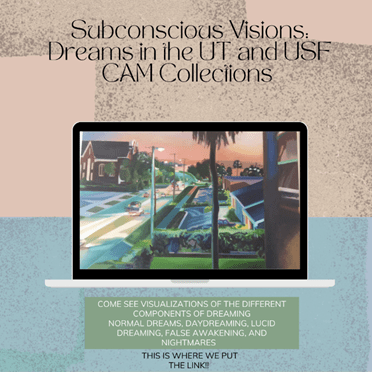
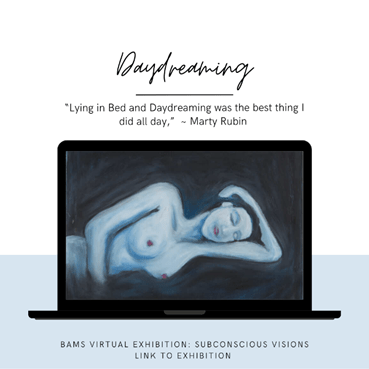
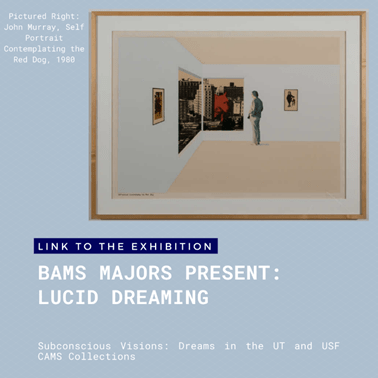
In order to reach the intended audience of students attending the two universities the marketing plan is focused on the different ways a student would gain information about school activities virtually. This is done in only two ways, through the social medias that promote art activities on campus and through mass emails to all students about events that occur with the school. Rather than writing a long-winded paragraph about the exhibition itself, graphics were made to promote the exhibition with the essential information. There are six different graphics that are developed to promote the exhibition in different ways. All of the graphics include the title of the exhibition as well as a link that when clicked will transfer the viewer to the exhibition with ease. The first graphic is one that fully encapsulates the exhibition as a whole, the title and an image from the exhibition. There is also a small accreditation to the galleries of University of Tampa and USF as an acknowledgement of where the artwork has come from. The subsequential graphics are all designed with different themes to differentiate the different themes that are existent within the exhibition itself but stay true to the ultimate goal of the exhibition.
The distribution plan leading to the “opening” of the exhibition was to contact the workers that run the social media accounts of the galleries and art and design social medias between the two universities and ask them to post the graphics for the exhibition. The plan was to post the main graphic on the day of the “opening” and then continue to post a new graphic every two to three days as the link remains public. Once all of the graphics are posted then the marketing would stop as far as posting brand new graphic to promote the exhibition. The graphics would be repeated with more time in between posts as the exhibition reaches its “closing date”. On the final day the link is available to the public is when the final graphic will be posted to the social media accounts. The goal of this marketing plan is to inform the public of the exhibition and give them the means to access the exhibition with ease. The advertising done to promote the exhibition is meant to draw attention and provide easy access for the audience, and this is done best through social media access.
Advertisement Graphics: Gabrielle Streeto
Advertisement for the Exhibition:
Advertisement for Typical Dreaming:

Advertisement for Day Dreaming
Advertisement for Lucid Dreaming:
Advertisement for False Awakening:
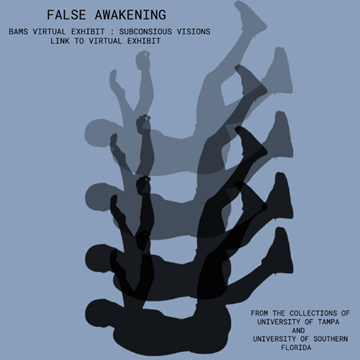
Advertisement for Nightmares:

Fundraising Plan: Alexandra Dardet
Subconscious Visions is a contemporary exhibition showcasing over 30 unique interpretations of the unconscious mind through art. This exhibition is designed to connect the audience to several different types of dreams that can occur throughout one’s life and showcase how artists can use art to visualize the different ways the subconscious presents itself during the night. In order to accomplish this, we wish to partner with several donors in the Tampa Bay area that are connected to sleep and dreaming. Three sponsors that we believe would benefit from partnering with Subconscious Visions are Mattress Firm, Tampa General Hospital Sleep Disorder Center, and the USF Neuroscience Institute.
What better way to advertise an exhibition on dreams than by having a comfy mattress to sleep on? This is why one of our top three sponsors is Mattress Firm. One reason this project could benefit Mattress Firm is because of its innate connection to sleep, comfort, and popularity. Imagine falling asleep on some of Mattress Firm’s luxurious mattresses and visiting a dream inspired by any of the paintings in the exhibition. Additionally, they can get name recognition and advertising through the exhibition’s social media accounts and marketing. A fantastic way this company can get visitors to interact with them during the virtual exhibition is by having a direct scannable link/QR Code at the end of the exhibition that directs them to their Mattress Matcher ® interactive survey that considers the sleeping positions and best bedding purchases for their customers. Mattresses are essential to a good night’s sleep, and Mattress Firm could benefit from museum visitors learning about their brand if they are interested in increasing their quality of sleep by purchasing newer mattresses, bed frames, and pillows.
While mattresses and pillows are essential to creating a comfortable sleeping experience, USF Neuroscience Institute is here to answer and research questions about what happens after falling asleep. This exhibition will feature and display various artworks from the USF art collection, and it would be a perfect opportunity to highlight the research and studies being conducted at USF Neuroscience Institute. According to their mission statement, the USF Neuroscience Institute “inspires hope for patients and families battling diseases of the brain through innovative research and collaborative care. Translating science to the human experience.” (USF Neuroscience Institute, 2022). While the institute primarily studies physical and neurological disorders, the USF Neuroscience Institute has conducted multiple studies on how the brain reacts to specific types of dreams. They conducted these studies by studying patients’ brainwaves and brain activity in MRI machines and similar medical instruments while the patient was asleep. This potential sponsor would be perfect for this exhibition because the University of Tampa campus is so close to the USF campus; USF Neuroscience Institute could benefit from potential student volunteers who wish to help further their research. Science is essential to understanding the human subconscious and having an academic institution as a sponsor would be incredibly exciting and an excellent opportunity for everyone involved.
Lastly, the final sponsor that could bring this exhibition together is the Tampa General Hospital Sleep Disorder Center. While the USF Neuroscience Institute’s primary mission is to address neuroscience as a whole, the Tampa General Hospital Sleep Disorder Center’s primary goal is to focus on the study of sleep. They conduct research on sleep and dreams, and the center assists patients suffering from chronic sleep disorders, such as insomnia, sleep apnea, and narcolepsy. Additionally, the Tampa General Hospital Sleep Disorder Center is one of the few centers in Florida “to be accredited by the American Academies of Sleep Medicine (AASM).” (Tampa General Hospital Sleep Disorder Center, 2022). Additionally, similarly to the USF Neuroscience’s sponsor proposal, the TGH Sleep Disorder Center could have the opportunity to search for potential volunteers that visit the exhibition for future research opportunities. Becoming a sponsor for this exhibition would also allow the center to advertise its mission and future projects in the exhibition’s social media and marketing campaigns. It would be an honor to have one of the best hospitals in Hillsborough County support an exhibition created by local University of Tampa students.
Fundraising for this project will become fast, simple, and comfortable, just like it is to sleep on one of Mattress Firm’s mattresses. Visitors to this exhibition would have the opportunity to educate themselves on scientific research from the USF Neuroscience Institute and the Tampa General Hospital’s Sleep Disorder Center. At the end, this exhibition would include a donation link where visitors viewing the virtual exhibition could make donations to the University of Tampa’s Scarfone/Hartley Gallery. This exhibition’s fundraising plan will not just be stuck in a dream but a memorable reality because of these generous donors and funding.
Copyright permissions
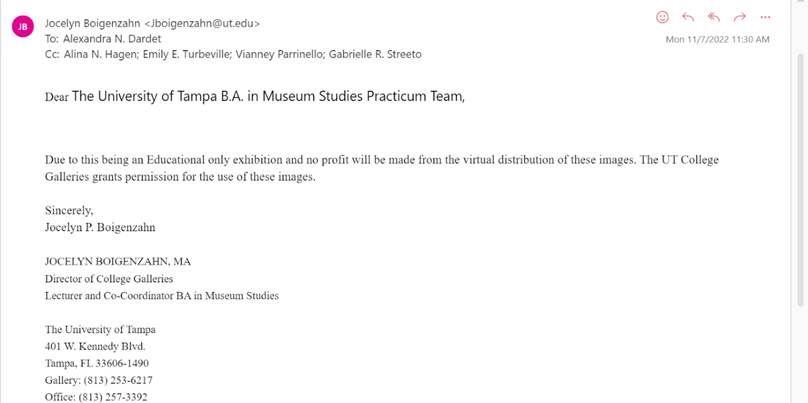
University of Tampa Image Permissions:
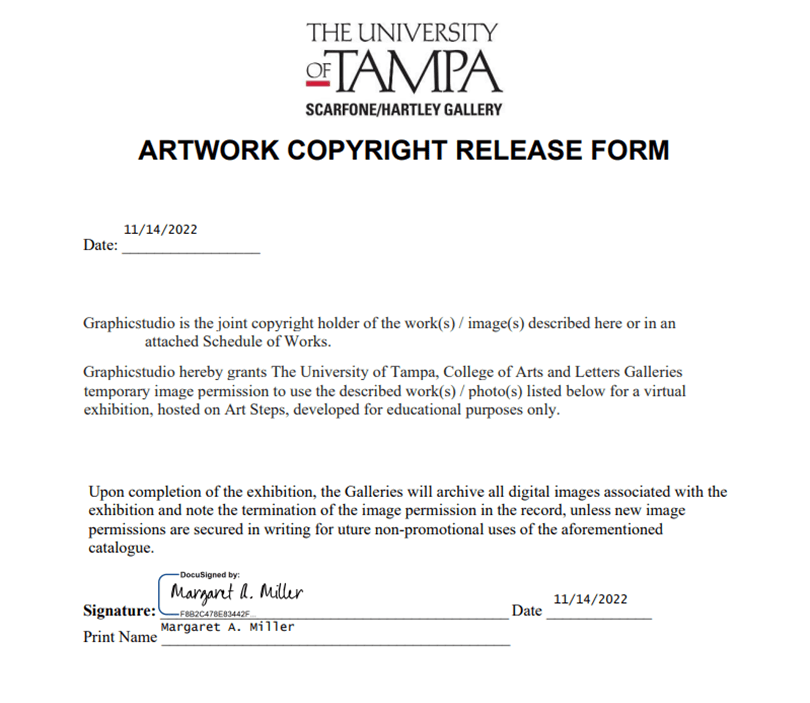
USF CAM Graphic Studio Copyright Release:
Stackhouse Estate Copyright Releasee

Brown Estate Communication:
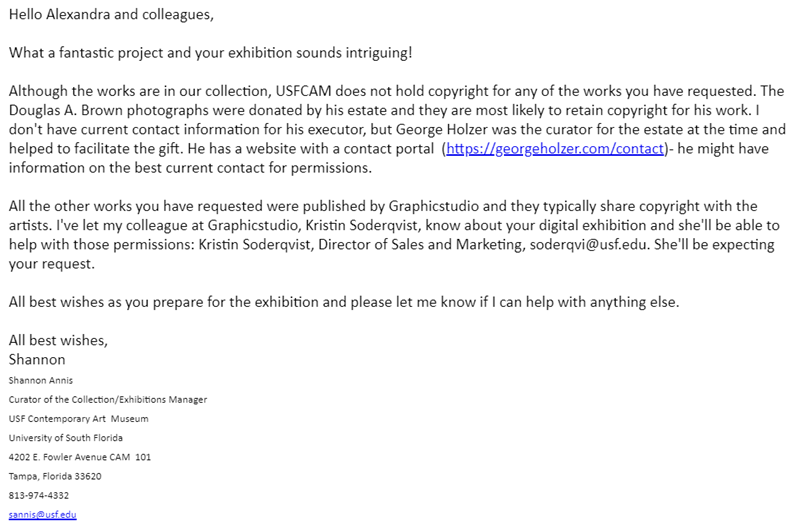
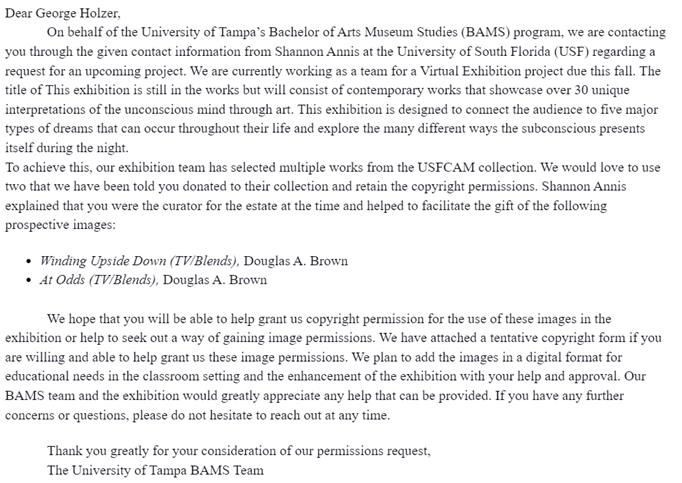
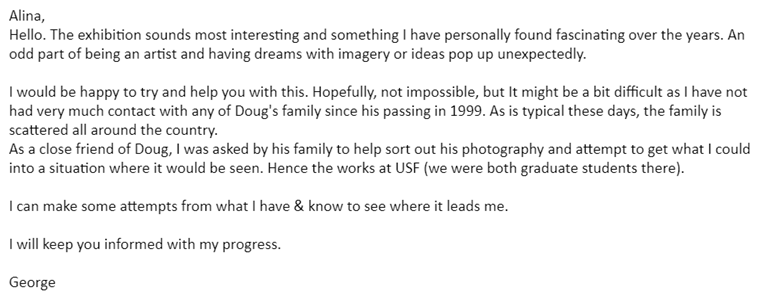
Unfortunately, the UT BAMS Practicum team was unable to reach the Brown Family. According to USF CAM, the works by Douglas Brown were donated by a man named George Holzer after Brown’s death, who retained copyright permission. When we reached out to Holzer, there was confusion, as Holzer was under the impression that copyright was held by USF CAM. Holzer and the UT BAMS team attempted to contact the Brown family, but we were unsuccessful in finding a next of kin with contact information. Below documents our contact with USF CAM and Holzer. The UT BAMS team will gladly remove the Brown works from this exhibition if contacted by the copyright holder.
Initial contact with USF:
Subsequent Contact with George Holzer:

Works Cited
Curatorial Statement Sources:
Barrett, Deirdre. (1990, June). Flying dreams, false awakenings, and lucidity: An empirical study of their relationship. Dreaming: Journal of the Association for the Study of Dreams. 1(2) pp. 129–134.
Blumberg, N. (2022, May 21.) Leonora Carrington. Britannica. https://www.britannica.com/biography/Leonora-Carrington
Cherry, K. (2020, April 17). What Is the Activation-Synthesis Model of Dreaming? Very Well Mind. https://www.verywellmind.com/what-is-the-activation-synthesis-model-of-dreaming-2794812
Freud, S. (1953). The Interpretation of Dreams (Second Part) and On Dreams. London: The Hogarth Press. ISBN 0-7012-0067-7.
Gilbert, Daniel T.; Killingsworth, Matthew A. (2010, November 12). A Wandering Mind is an Unhappy Mind. Science. 330(6006): 932. doi:10.1126/science.1192439. ISSN 0036-8075.
Martins, K. (2022, August 14). Lucid Dreams. WebMD. https://www.webmd.com/sleep-disorders/lucid-dreams-overview
Packer, Sharon (2002). Dreams in Myth, Medicine, and Movies. Westport, CT: Praeger Publishers. ISBN 0-275-97243-7.
Rooksby, B., Terwee, S. (1990, December). Freud, van Eeden, and Lucid Dreaming. Lucidity Letter. 9(2).
Schredl, M. (2014, April 29) Nightmares and Stress in Children. Sleep and Hypnosis 10.1 (2008): 19–25. ProQuest. Web.
Schwarz, W (1996). “Hermann Rorschach, MD: His life and work”. Rorschachiana. 21 (1): 6–17. doi:10.1027/1192-5604.21.1.6
Sharma, A. (n.d.). Psychoanalytic Theory of Art and Literature – Explained. Psychology Discussion. https://www.psychologydiscussion.net/theory/psychoanalytic-theory-of-art-and-literature-explained/493
van Eeden, F. (1913). A study of dreams. Proceedings of the Society for Psychical Research, 26, 431-461. (Reprinted in: R.L. Woods (Ed.), The world of dreams. New York: 1947, pp. 309-321 (partial); in Celia Green, Lucid dreams, Oxford: 1968 (partial); and in C.T. Tart (Ed.), Altered states of consciousness, New York: 1969/1975, pp. 145-158.)
Fundraising Works Cited:
Mattress Firm, (2022). About Us. Mattress Firm. https://www.mattressfirm.com/about.html
Tampa General Hospital, (2022). Sleep Disorders Center. TGH Tampa General Hospital. https://www.tgh.org/institutes-and-services/ent-institute/sleep-disorders-center
USF Administration, (2022). USF Health Neuroscience Institute. The University of South Florida. https://giving.usf.edu/neuroscience
 HAGEN // ANALYTICS
Leave a comment